Austin City Council members are facing growing challenges in finding a way to pay for the city’s ambitious “Cap and Stitch” project over Interstate 35, as discussions continue over how to fund the multi-hundred-million-dollar effort.
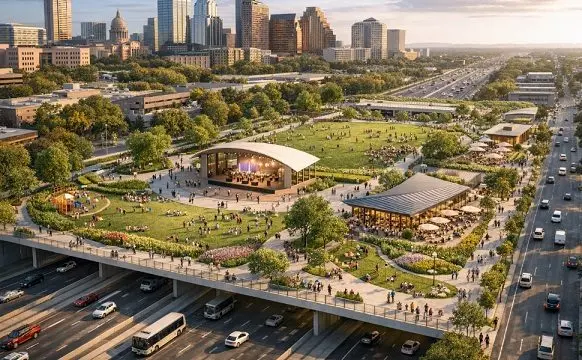
During a recent work session, city staff presented a potential financing plan for the project, which aims to build decks over portions of I-35 that would eventually support parks, public spaces, and pedestrian connections across the highway.
The discussion comes as the city faces a looming deadline to decide how much, if any, funding it will commit toward the project, with the Texas Department of Transportation needing guidance as it finalizes construction plans for the broader I-35 expansion.
While the concept has long been part of Austin’s vision to reconnect downtown with East Austin, the price tag remains a major sticking point.
Estimates suggest the decks alone could cost hundreds of millions of dollars, with some projections for the broader project exceeding $1 billion when amenities like parks and public features are included.
Complicating matters further, the city recently lost a roughly $105 million federal grant that had been expected to help offset costs, leaving officials to search for new funding sources.
City staff also warned council members about financial risks tied to inflation, construction costs, and the possibility that Austin could be responsible for cost overruns as the project moves forward.
Supporters of the Cap and Stitch project argue it represents a once-in-a-generation opportunity to reshape the city.
They say the decks could reconnect communities historically divided by I-35, create new green space, and boost economic development in the urban core.
Some council members have pointed to the potential for increased property values and tax revenue, as well as the creation of what could become one of the city’s signature public spaces.
Advocates also argue that failing to act now could mean losing the opportunity for decades, since the underlying highway construction will not be revisited once completed.
At the same time, opposition—both within City Hall and among residents—continues to center on cost and priorities.
Critics argue the project could divert funding away from more immediate needs, including affordable housing, homelessness services, and basic infrastructure.
Some council members have expressed concern about committing large sums of money without a clear funding plan, especially as the city faces broader budget constraints and revenue limitations.
Others have questioned whether Austin should take on a project of this scale given economic uncertainty and rising costs, warning that taxpayers could ultimately bear the burden.
City leaders are expected to continue refining a funding strategy in the coming weeks, with key decisions anticipated ahead of a state deadline later this year.
For now, the Cap and Stitch project remains a major point of debate at City Hall—balancing a long-term vision for Austin’s future against the financial realities of the present.